Why Do We Choose Blueprint for End-to-End Software Solutions?
Why Do We Choose Blueprint for End-to-End Software Solutions?
The success of a software project is determined not only by the final product, but also by how the project is managed from the initial idea through to live deployment. By bringing together its technology consulting and software development capabilities, Blueprint analyzes organizations’ requirements, develops the right technology strategy, and delivers projects from end to end.
Technology requirements are becoming increasingly complex for organizations. Developing a website, mobile application, or enterprise software solution independently is often no longer sufficient.
Different systems need to communicate with one another, existing infrastructures need to be modernized, data needs to be managed effectively, security needs to be ensured, and the software needs to be designed to support future growth.
For this reason, rather than simply receiving “software development” services, organizations increasingly need an end-to-end approach that evaluates business objectives and technology together.
This is where Blueprint comes in.
A Process That Starts with Understanding Requirements
The starting point of every project is not writing code, but understanding the problem correctly.
Before starting a project, Blueprint analyzes the organization’s existing structure, user requirements, business processes, and technical requirements.
Based on this analysis, the project scope, priorities, and technical requirements are clearly defined.
The goal is not simply to develop the software requested, but to create a technology solution that addresses the organization’s actual requirements.
The Right Strategy Through Technology Consulting
Choosing the wrong technology can lead to significant costs as a software project progresses.
Blueprint evaluates technology choices not only based on current technologies, but also on the project’s requirements, existing systems, scalability, performance, security, and long-term maintenance requirements.
This approach enables technology decisions to be made as early as possible, rather than after the project is already underway.
The goal is not to use the most technology, but to use the right technology for the requirements.
One Integrated Process from Design to Software Development
For a successful digital product, the user experience and technical infrastructure need to work in harmony.
Blueprint can manage different stages, from user experience and interface design to software development, within the scope of a unified project approach.
How users will interact with the platform, how business workflows will operate, and how these experiences will be supported by the technical infrastructure are evaluated together.
This helps reduce disconnects between design and software development while creating a more consistent digital experience.
Solutions Designed to Work with Existing Systems
Most organizations do not want to completely replace their existing systems when developing new software.
ERP and CRM systems, payment platforms, enterprise services, databases, and third-party applications may need to work alongside newly developed platforms.
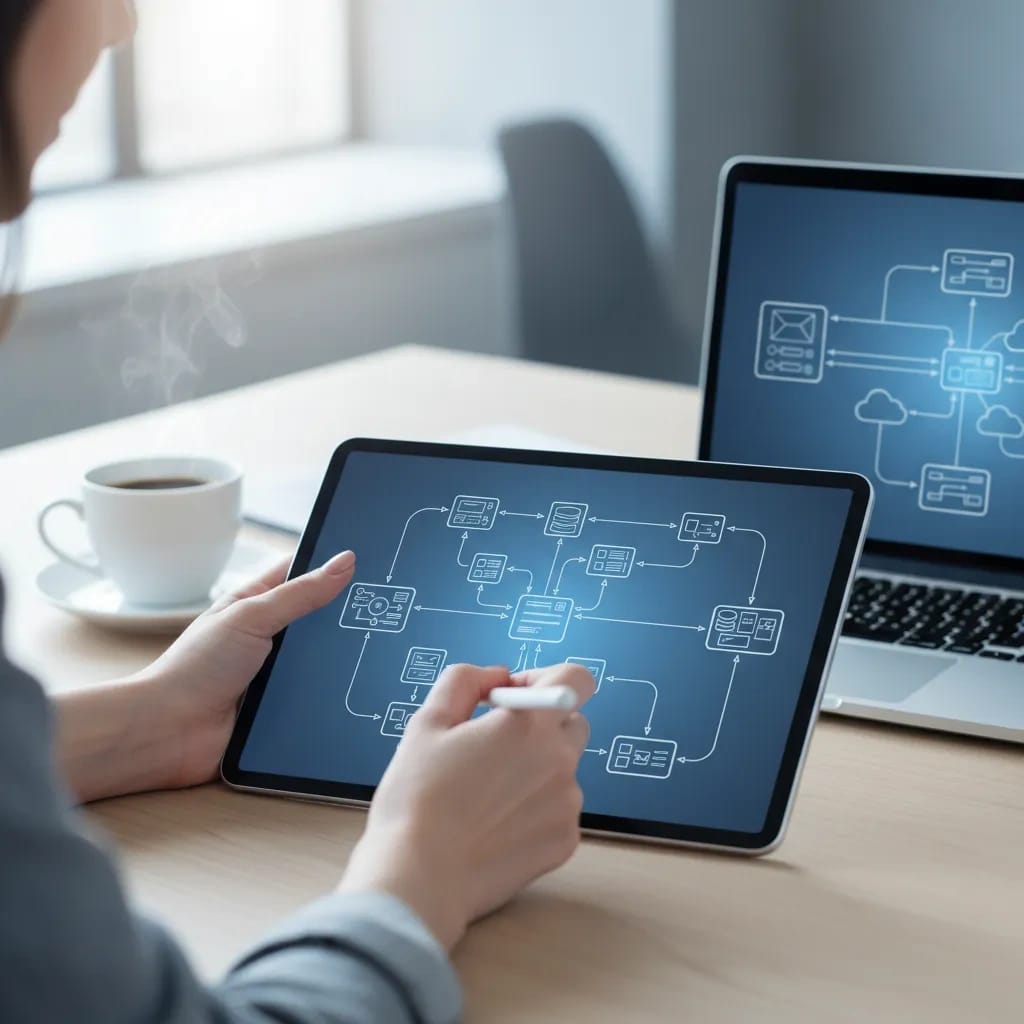
Blueprint designs API- and integration-focused architectures that enable different systems to communicate with one another.
The goal is to create an integrated solution that works alongside the organization’s existing technology ecosystem rather than becoming an isolated system disconnected from it.
Security and Performance Are Designed from the Start
Security and performance are not treated as areas that should only be reviewed at the final stage of a software project.
Security, performance, and scalability requirements are taken into consideration while the system architecture is being designed.
Potential future requirements, such as an increase in the number of users, growing data volumes, or the addition of new services, are considered from the outset so that the infrastructure can be designed accordingly.
This approach ensures that the software is built not only to work effectively today, but also to address the requirements of tomorrow.
From Development to Deployment and Beyond
Blueprint’s end-to-end approach does not end with software development.
Testing, environment management, versioning, deployment, and subsequent improvements are all considered part of the project lifecycle.
Modern development and automation methods can reduce repetitive operations and enable software teams to work in a more controlled and efficient way.
This structure supports the more consistent development of new features and enables the product to be continuously improved over time.
Smarter Development Processes with Artificial Intelligence
Artificial intelligence technologies are considered an important component of next-generation development processes within Blueprint’s technology approach.
AI-powered tools can be used across various areas, including software development, documentation, testing, data analysis, and content processes, helping increase team productivity.
However, AI is not treated as a standalone solution, but as a technology used together with the right architecture and human expertise.
This approach aims to combine the speed enabled by technology with the reliability provided by engineering expertise.
Scalable and Sustainable Infrastructure
A software project needs not only to meet today’s requirements, but also to be capable of supporting future growth.
Scenarios such as increasing user numbers, adding new modules, integrating with different systems, or expanding into new markets need to be considered from the outset to ensure the long-term sustainability of the software.
With this perspective, Blueprint aims to build architectures that are as modular, extensible, and scalable as possible.
Why Blueprint?
At the heart of Blueprint’s end-to-end approach is a single objective:
To approach organizations’ technology requirements not simply as a software project, but as a long-term technology investment.
Starting with requirements analysis, the process continues through technology consulting, UX/UI design, software development, integration, testing, deployment, and continuous improvement.
This enables organizations to build an integrated technology structure that progresses within a unified technology vision rather than relying on disconnected solutions for different processes.
Blueprint provides an end-to-end technology approach that transforms ideas into strategy, strategy into design, design into software, and software into a sustainable digital product.
